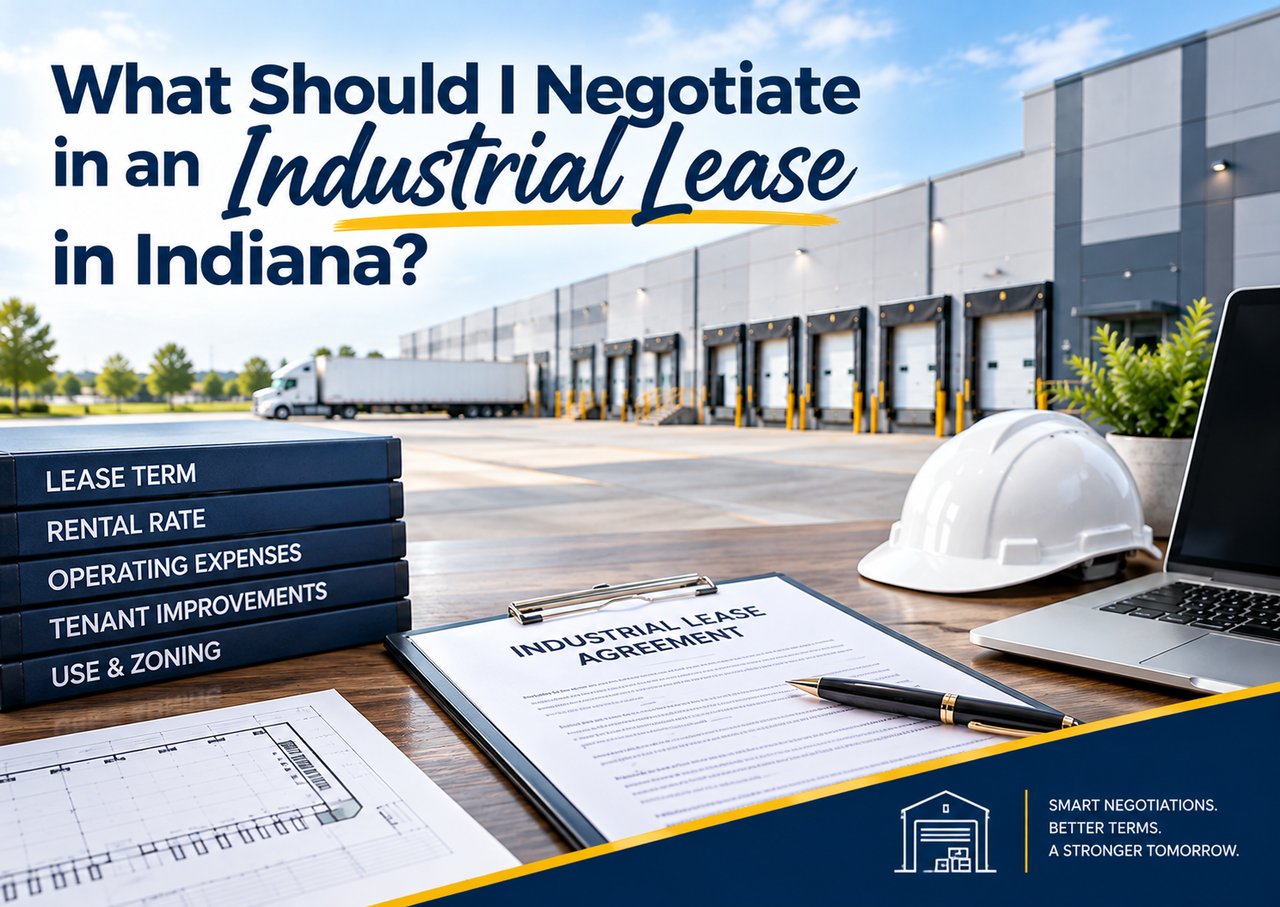
Most business owners focus on one number when leasing industrial space: base rent. But an industrial lease in Indiana contains dozens of terms that can cost — or save — far more over a five- or ten-year term. Landlords negotiate leases every week; most tenants negotiate one every five to ten years. Here are the industrial lease terms I negotiate for clients in Indianapolis, Carmel and across Central Indiana.
1. Free rent
Landlords often offer several months of free (abated) base rent, especially on longer terms or in buildings that have been vacant. Clarify whether NNN charges are also abated during the free-rent period.
2. Tenant improvement allowance
A TI allowance funds office upgrades, restrooms, lighting, electrical work, HVAC or other improvements. Generic improvements that help future tenants are easier to fund than highly specialized ones.
3. Annual rent escalations
Most industrial leases in Indiana include fixed annual increases. A lower escalation compounds into significant savings over a long term.
4. Operating expense protections
Negotiate caps on controllable CAM expenses, exclusions for capital replacements and audit rights to review the landlord's books.
5. Roof, structure and HVAC responsibility
Clarify who repairs and replaces major systems. Ask for a roof inspection, HVAC service and warranty at move-in.
6. Renewal options
Secure the right to extend your lease, ideally at a defined rent or a fair-market formula with a cap. Renewal options protect businesses that invest in equipment and improvements.
7. Expansion rights
A right of first refusal or right of first offer on adjacent space protects growth, especially in tight markets like Hamilton County.
8. Assignment and subletting
If you sell your business, merge or downsize, you'll want flexibility to assign or sublet without unreasonable landlord restrictions.
9. Use clause
Make the permitted use broad enough to cover future business lines. A narrow use clause can block growth or a sale of your company.
10. Restoration obligations
Define exactly what you must remove when the lease ends. Racking, cranes, wiring, equipment pads and mezzanines can be expensive to remove if the lease requires it.
11. Signage, yard and parking rights
Secure exterior signage, dedicated parking and any outdoor storage area in writing.
12. Early termination
Some landlords will grant a termination option in exchange for a fee. It can be valuable for businesses with uncertain growth.
How to create leverage in an industrial lease negotiation
The best leverage is real alternatives. I keep two or three buildings in play until terms are final, request proposals from multiple landlords and compare total occupancy cost. Landlords negotiate differently when they know a tenant has options. Timing matters too — starting early prevents landlords from using your deadline against you.
The order I negotiate industrial lease terms in Indiana
Not every term carries the same weight, and a smart industrial lease negotiation in Indiana focuses energy where the money is. I generally prioritize in this order:
1. Total economics: base rent, escalations, free rent and TI together, measured as net effective rent over the full term
2. Expense exposure: NNN caps, capital replacement exclusions and responsibility for roof, HVAC and parking
3. Flexibility: renewal options, expansion rights, assignment and subletting
4. Exit costs: restoration obligations and security deposit return
5. Operational details: signage, parking, yard rights, access hours and use clause
This keeps the negotiation focused and prevents a tenant from winning small points while giving up large ones.
Net effective rent: the number that matters most
Net effective rent spreads free rent, TI and escalations across the lease term to show what you really pay on average. Two proposals with the same asking rent can have very different net effective rents once concessions are included. I calculate this for every proposal so clients can compare offers apples to apples. In my experience, a tenant who understands net effective rent negotiates differently — and usually better — than one focused only on the first-year rate.
A note on letters of intent
Most industrial lease negotiations in Indiana start with a non-binding letter of intent (LOI). The LOI is where the major business terms get settled, so it deserves as much attention as the lease itself. Anything left out of the LOI becomes much harder to win once the landlord's attorney drafts the lease.
Frequently asked questions about industrial lease negotiation in Indiana
Is rent negotiable on industrial space in Indianapolis? Often, especially in segments or buildings with vacancy. Concessions may also come as free rent or improvement allowances.
What is a typical industrial lease term in Indiana? Three to five years for small spaces, five to ten years or longer for larger and specialized users.
Should an attorney review my industrial lease? Yes. A broker negotiates business terms; an attorney reviews legal language.
Negotiate your industrial lease with Annie Scott
I represent tenants across Indianapolis, Carmel, Fishers and Central Indiana and negotiate every term that affects your bottom line — not just the rent.
Annie Scott — Annie Scott Realty Group LLC / F.C. Tucker Company Cell: (317) 902-8622 ·