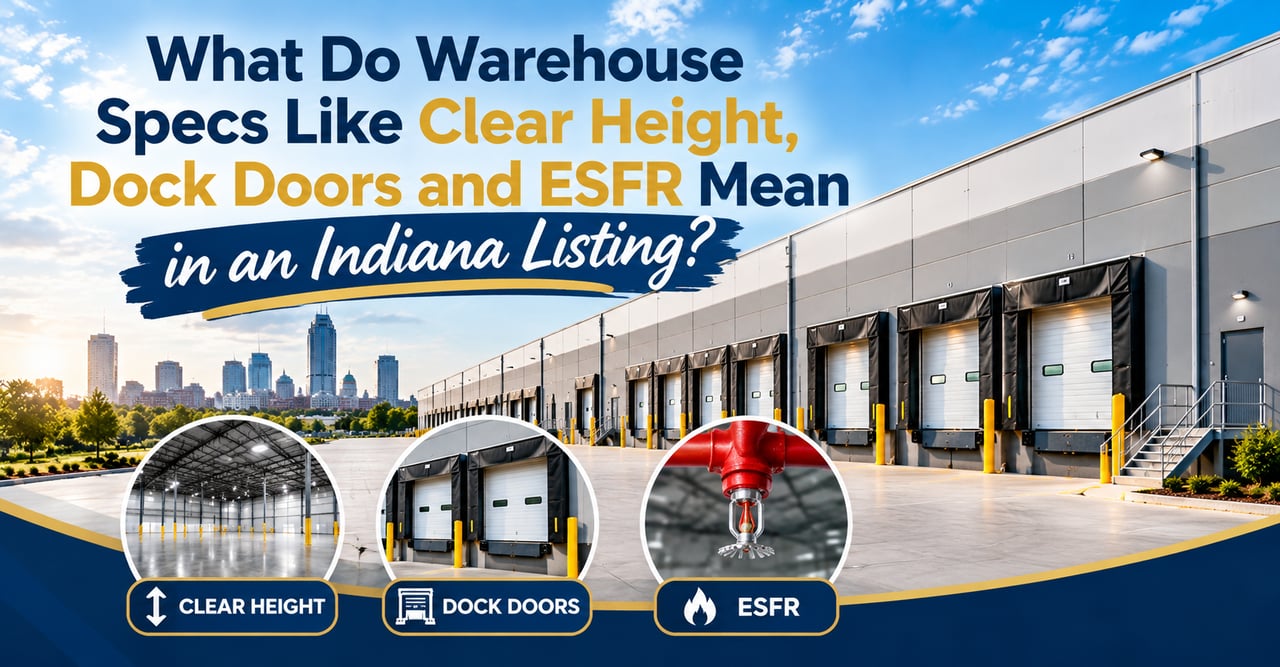
Industrial property listings in Indianapolis and across Indiana can read like a foreign language. Clear height, dock-high, drive-in, ESFR, 480V three-phase, column spacing, truck court depth — every term affects how well a building works for your business and how much it's worth. Here's how to read an industrial property for sale or lease in Indiana like an expert.
Total square feet and office percentage
Industrial buildings include some office space, but too much can be a problem. Most warehouse users want 5% to 15% office; flex users may want 20% to 50%. If a 20,000-square-foot warehouse has 8,000 square feet of office, you may be paying for space you can't use.
Clear height
Clear height is the usable vertical space from the floor to the lowest overhead obstruction — joists, beams, sprinkler pipes or lights. It's not the roof peak. More clear height means more storage per square foot.
• Contractors and service businesses: 14–20 feet
• Light manufacturing: 18–24 feet
• Local distribution: 24–30 feet
• Regional distribution: 32 feet and up
Dock-high doors
Dock-high doors sit about four feet above the ground so semi-trailers and box trucks can load at floor level. Look for dock levelers, seals or shelters, bumpers, lights and vehicle restraints.
Grade-level (drive-in) doors
These doors sit at ground level so vans, box trucks and forklifts can drive inside. Contractors and service businesses usually need at least one or two. Note the size: 12x14 feet is common; larger equipment may need 14x16 or more.
Power
Listings usually show power in amps and volts, like "800A, 480V, 3-phase." Manufacturers, automated warehouses and EV fleets need to confirm power early, because upgrades through Duke Energy Indiana, AES Indiana or another utility can be expensive and slow.
Sprinklers: ESFR vs. conventional
ESFR (Early Suppression, Fast Response) systems allow high-piled storage without in-rack sprinklers. Distributors stacking above about 20 feet usually want ESFR. Older conventional systems may limit storage heights or commodities.
Column spacing
Columns support the roof. Wider spacing gives more flexibility for racking and equipment. Modern bulk buildings use larger bays than older ones.
Truck court depth and trailer parking
Truck court depth is measured from the dock wall to the edge of the paved area. Deeper courts (often 120 to 185 feet) let 53-foot trailers maneuver and stage. Trailer parking matters for distributors.
Car parking
Labor-intensive operations need parking for every shift. Check the ratio of parking spaces to building size.
Zoning
Confirm the zoning district allows your use, especially in Carmel, Fishers and other Hamilton County communities with tighter rules.
Lease rate and NNN charges
Asking rent is usually quoted per square foot per year, plus estimated NNN expenses for taxes, insurance and maintenance. Add both together to know your real cost.
How to tour an industrial property in Indiana like an expert
Listings tell you the specs; tours tell you the truth. When I tour industrial property for sale or lease in Indiana with clients, we check:
• The roof: look for stains, buckets, patched leaks and daylight. Ask the roof's age and warranty.
• The floor: cracks, uneven joints and heaving can damage forklifts and racking.
• The docks: test levelers and doors, and check seals and bumpers.
• The electrical room: confirm the service size and panel condition with your electrician.
• The truck court: watch a truck maneuver if possible, and look at drainage and pavement condition.
• The neighbors: residential neighbors, traffic patterns and nearby uses affect your operation.
• The office: confirm restrooms, HVAC and layout fit your team.
Take photos and notes in every building. After three or four tours, buildings blur together, and good notes make comparisons easier.
Questions to ask the landlord or seller
• Why is the space available?
• How old are the roof, HVAC units and dock equipment?
• What are actual operating expenses for the last two years?
• Are there any tax abatements, and when do they expire?
• Has the property had any environmental reports?
• What improvements will the landlord fund?
The answers shape both your decision and your negotiation.
Frequently asked questions
What does clear height means in a warehouse listing? The usable height from the floor to the lowest overhead obstruction.
What is the difference between dock-high and drive-in doors? Dock-high doors load trucks at floor level; drive-in doors let vehicles enter at ground level.
What does ESFR mean? Early Suppression, Fast Response — a sprinkler system that supports high-piled
storage.
How do I know if a building has enough power? Ask for the electrical service size and recent utility bills, and have an electrician review your load.
Get expert help evaluating industrial property in Indiana
I review Indiana industrial listings with clients every week and know which specs matter for each operation. Let me help you narrow the field and avoid costly surprises.
Annie Scott — Annie Scott Realty Group LLC / F.C. Tucker Company Cell: (317) 902-8622 ·