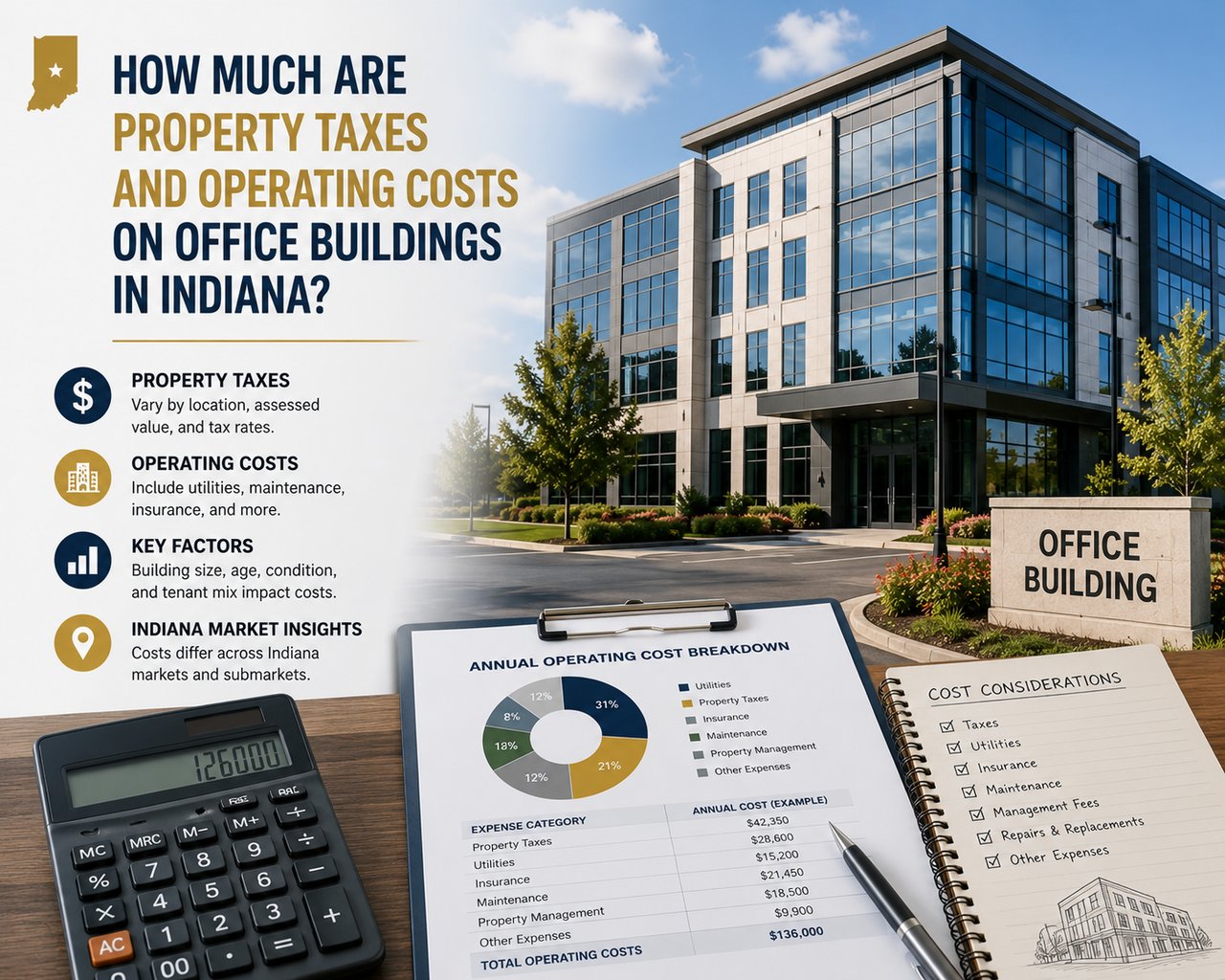
Operating costs determine how much income an office building produces and how competitive it is for tenants. Understanding office building operating costs in Indiana helps buyers underwrite accurately, owners manage efficiently and tenants budget wisely.
Property taxes
Indiana's constitution caps property taxes on commercial property at 3% of gross assessed value. Actual tax bills vary by county and taxing district. Some newer buildings benefit from local tax abatements that phase out over time, increasing taxes in later years.
Insurance
Property insurance costs have risen in many markets. Building age, construction, roof condition, fire protection and claims history affect premiums.
Utilities
Office buildings consume significant energy for HVAC, lighting and elevators. Efficient systems, LED lighting and smart controls can reduce costs.
Janitorial
Multi-tenant office buildings typically provide janitorial service for tenant suites and common areas, a major operating expense.
Repairs and maintenance
HVAC service, elevator maintenance, plumbing, electrical and general repairs add up. Preventive maintenance reduces emergencies.
Grounds and parking
Landscaping, snow removal and parking lot maintenance are especially important in Central Indiana winters.
Security and management
Access control, security staff where needed and professional management fees round out expenses.
How costs are passed to tenants
In full-service leases, landlords pay expenses up to a base year and pass through increases. In net leases, tenants pay their share directly. Understanding recovery helps buyers estimate true NOI.
Reducing operating costs
• Appeal property tax assessments when appropriate
• Rebid service contracts
• Invest in energy efficiency
• Implement preventive maintenance
• Monitor utility usage
An example of cost savings
The owner of a suburban office building in Indianapolis upgraded to LED lighting, installed new building controls and rebid janitorial and landscaping contracts. Operating costs dropped, improving NOI and making the building more competitive for tenants.
Benchmarking your building
Owners can compare their operating costs per square foot with similar buildings to identify savings opportunities. Brokers, property managers and industry surveys can provide benchmarks. If your janitorial, utility or maintenance costs are well above comparable buildings, investigate why. Lower operating costs make your building more competitive, especially in full-service leases where tenants compare total occupancy costs.
Planning for tax abatement expirations
If your building benefits from a tax abatement, plan for the increase as it phases out. Budget for higher taxes, consider how pass-throughs will affect tenants and adjust leasing strategies accordingly. Buyers should model abatement schedules carefully when estimating office building operating costs in Indiana, since expiring abatements can reduce NOI significantly.
Frequently asked questions
What is Indiana's property tax cap for commercial property? 3% of gross assessed value.
Do tenants pay office operating costs? Often through pass-throughs or net leases.
How can owners reduce expenses? Efficiency upgrades, contract rebidding and tax appeals.
Understand office operating costs
I help Indiana buyers, owners and tenants analyze office operating costs and their impact on value and rent.
Annie Scott — Annie Scott Realty Group LLC / F.C. Tucker Company Cell: (317) 902-8622 ·